
Science has an odd place in primary assessment. It is a core subject, it is reported at the end of Key Stage 2, and yet for most year groups there is no national test to tell you how secure children are. This guide sets out a practical, low-workload way to assess science from Year 2 to Year 6, and to turn the results into teaching.
What is actually required
- Year 6: science is judged by teacher assessment at the end of Key Stage 2. The framework has a single standard – a pupil is either working at the expected standard or has not met it. It is statutory, and it goes to the Department for Education with your other KS2 results.
- Year 2: end of Key Stage 1 teacher assessment is no longer statutory, so any science assessment is for your own school’s use.
- Years 3, 4 and 5: there are no national requirements at all. What you assess, and how, is a school decision.
- The national sampling tests: from 2014 to 2018 a sample of schools sat KS2 science sampling tests to monitor national standards. They gave no results to schools, the papers were never published in full, and they have not run since 2018.
So most of the evidence for science comes from you. The question is how to make that evidence reliable without adding a heap of marking.
Why a short end-of-year test helps
Teacher assessment works best when it draws on a range of evidence: books, practical work, talk and questioning. A short written test adds something those sources struggle to give you – the same questions, answered in the same conditions, by every child.
- It shows which topics a class has secured and which have faded since they were taught.
- It shows which working scientifically skills are weak: reading a table, spotting an unfair test, drawing a conclusion.
- It gives the next teacher a clear starting point in September.
- It gives subject leaders a picture across the school, year group by year group.
A test is not a replacement for teacher judgement. It is one piece of evidence – but it is the piece that is easiest to compare.
What a good primary science test looks like
It covers the year’s programme of study
Every statement in the national curriculum for that year should have a chance to show up. If a test only samples two topics, it tells you very little about the rest. A sensible length is about 40 marks for Years 4 to 6, 30 for Year 3 and around 25 for Year 2.
Working scientifically is built in
The best science questions test knowledge and enquiry skills together: a table of results about dissolving, a graph of pulse rate, a question about which variable to keep the same. Around a third of the marks should involve working scientifically, as the national sampling tests did.
Short parts, not one long sitting
Splitting the test into short parts – biology, chemistry and physics – keeps younger children fresh and lets you give the parts on different days.
The reading load is fair
A science test should not become a reading test. Clear pictures, short sentences and the option for an adult to read questions to children who need it all help. In Year 2, most children can read a well-designed test themselves, with support for those who need it.
The mark scheme is precise
Good science mark schemes say what to accept and what not to accept. Without that, two teachers will mark the same answer differently, and the results lose their value.
Turning results into teaching
Marking the test is only half the job. The value comes from looking at the results question by question, rather than just totals.
- Look for the questions most of the class got wrong. These are your reteach priorities – often a misconception, such as thinking light comes out of our eyes, or that heavier objects always fall faster.
- Compare topics and skills. A class can be secure on the content of a topic but weak at interpreting results. That tells you to build more enquiry into teaching, not more facts.
- Group children who need the same help. Two or three children struggling with the same idea can be taught together in a short catch-up session.
- Pass it on. Give the next teacher a one-page summary: what the class secured, what needs revisiting, and who needs support.
This is exactly what a question level analysis (QLA) does. Type in each child’s marks and it shows every question, topic and skill for the year group, a class or a group, and produces a one-page report for each child.
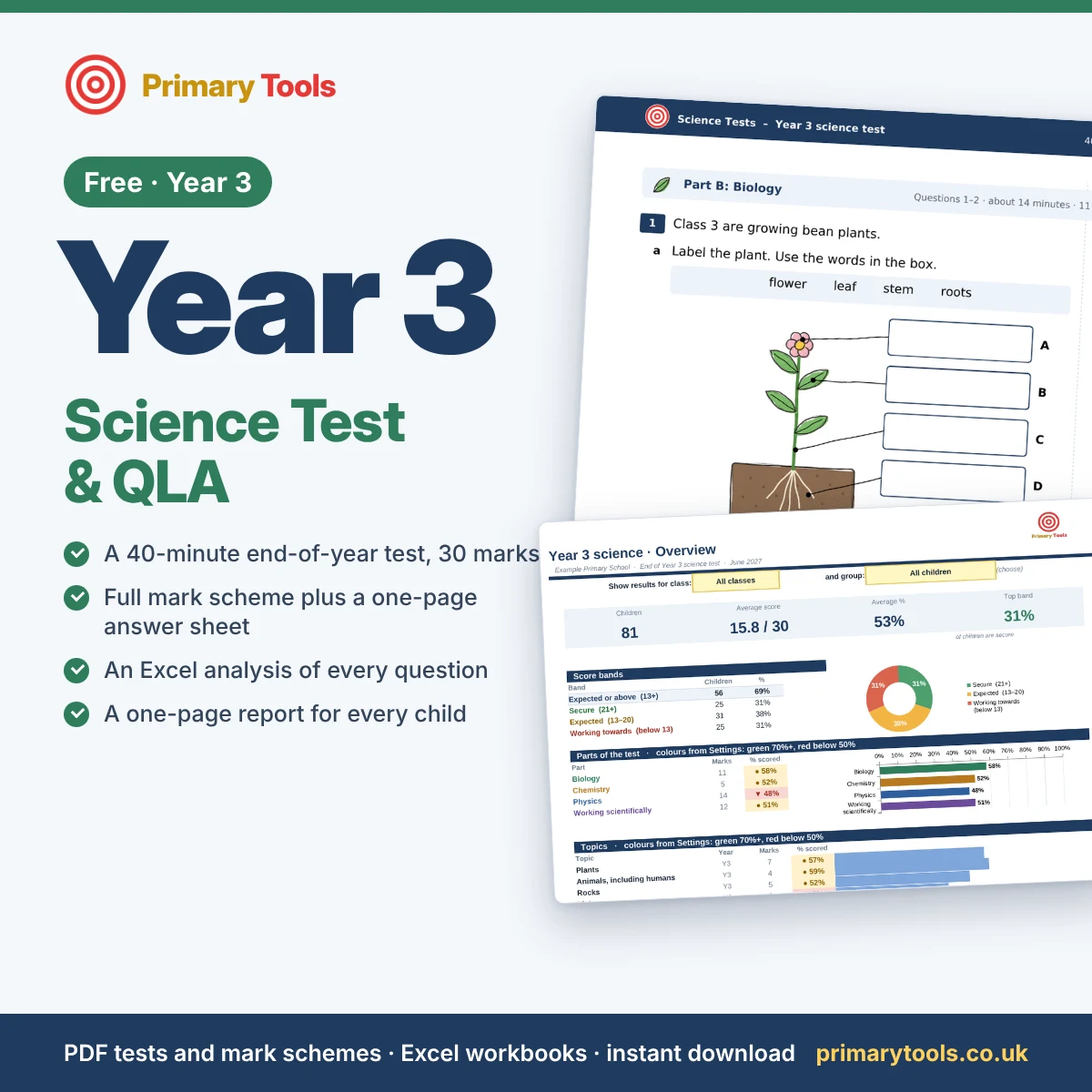
Science tests for Years 2 to 6
End-of-year tests with full mark schemes, a one-page answer sheet and an Excel question level analysis for every year group. Try the complete Year 3 pack free.
Free Year 3 science testYear Group TestsWhen to test
- End of the summer term – the most common choice, to check what has been secured over the year and inform reports and handover.
- Start of the next year – using the previous year’s test as a baseline, so the new teacher sees what has been retained after the holidays.
- Both – which shows you what sticks and what fades, and is especially useful for subject leaders.
Common questions
Should we use the test result as the teacher assessment judgement?
No. In Year 6 especially, the teacher assessment judgement should draw on the full range of evidence. Use the test to inform and check that judgement, not to replace it.
Can children with SEND take part?
Yes. Use the access arrangements you would normally use – reading questions aloud, extra time, rest breaks – and note them, so the results are read in context.
Do we need to test every year group?
Not necessarily, but testing every year group gives subject leaders a consistent picture and makes handover much easier.
Last updated November 2026. Statutory requirements change: check the current Standards and Testing Agency guidance for your year.
Leave a Reply